Principal Investigator
Johannes Pollanen

Johannes is the Cowen Distinguished Chair in Experimental Physics and an Associate Professor in the Department of Physics and Astronomy at MSU. He is also the Co-Director of MSU's Center for Quantum Computing Science and Engineering (MSU-Q) and a co-founder and board member of the Midwest Quantum Collaboratory. Johannes is also a member of the US National High Magnetic Field Laboratory's DC Field/High B/T Advisory Committee. He thinks qubits, electrons, superfluids, superconductors and hybrid quantum systems are very cool. He's also pretty good at hard soldering, leak checking, threading the wire-bonder and machining ... or at least he used to be.
Before joining the faculty at Michigan State, Johannes was an IQIM postdoctoral scholar at the Institute for Quantum Information and Matter (IQIM) at the California Institute of Technology working with Prof. Jim Eisenstein. At Caltech, he studied the exotic properties and many-body quantum states of single and bilayer 2d electron systems in ultra-clean semiconductor heterostructures grown via molecular beam epitaxy (MBE).
Johannes earned his Ph.D. in 2012 from Northwestern University where he worked with Prof. Bill Halperin in the Low Temperature Physics Group investigating the properties of complex many-particle quantum systems and engineering novel quantum mechanical forms of matter. During this time, Johannes discovered a new chiral state of superfluid 3He, which he stabilized by introducing anisotropic disorder to the superfluid in the form of high porosity silica aerogel.
Postdocs & Visiting Researchers
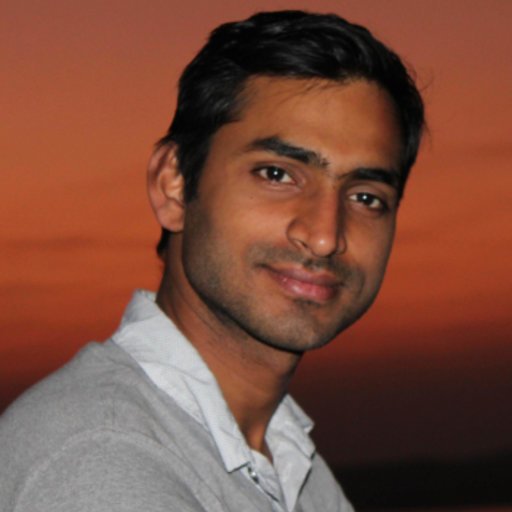
Dr. Pranaya Rath
Pranaya earned his Ph.D. in physics from IISc Bangalore in India. During this time he investigated the properties of multi-electron bubbles in liquid helium working with Prof. Ambarish Ghosh. At the LHQS Pranaya is working to develop novel surface acoustic wave (SAW) and bulk acoustic wave (BAW) devices for interfacing with superconducting qubit systems.
Dr. Kyle T. Lewallen
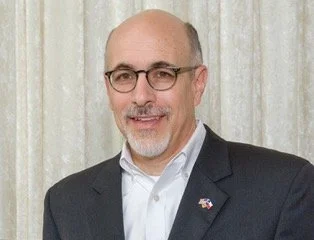
Kyle graduated from Michigan State University in 1984 with a B.S. in Geological Sciences (now Earth and Environmental Sciences) followed by a M.S. in Geophysics at Texas A&M University and eventually a Ph.D. in Geophysics at the University of Wisconsin - Madison. He worked for 32 years as a Geophysicist in the Oil & Gas business and retired from ExxonMobil in 2021. During his career, Kyle designed and acquired 3D seismic surveys for ExxonMobil’s worldwide affiliates and led research to improve subsurface imaging using ultra-low frequencies and multicomponent seismic data. His intellectual hobby in retirement is learning more about quantum physics by volunteering in the Laboratory for Hybrid Quantum Systems. Currently he is working to develop novel electron emission sources for electron on helium hybrid devices.
Dr. Hyunjin Choi
Hyunjin earned his Ph.D. in Physics from the Korean Advanced Institute of Science and Technology (KAIST), in South Korea, where he worked with Prof. Hyoungsoon Choi on the nonlinear dynamics and interactions between nanomechanical resonators and superfluid helium. At the LHQS, he is expanding his research to hybrid quantum systems integrating circuit quantum electrodynamics (cQED), superfluid helium, and electrons on helium. Outside of the lab he enjoys playing the piano and devoted accompanist.
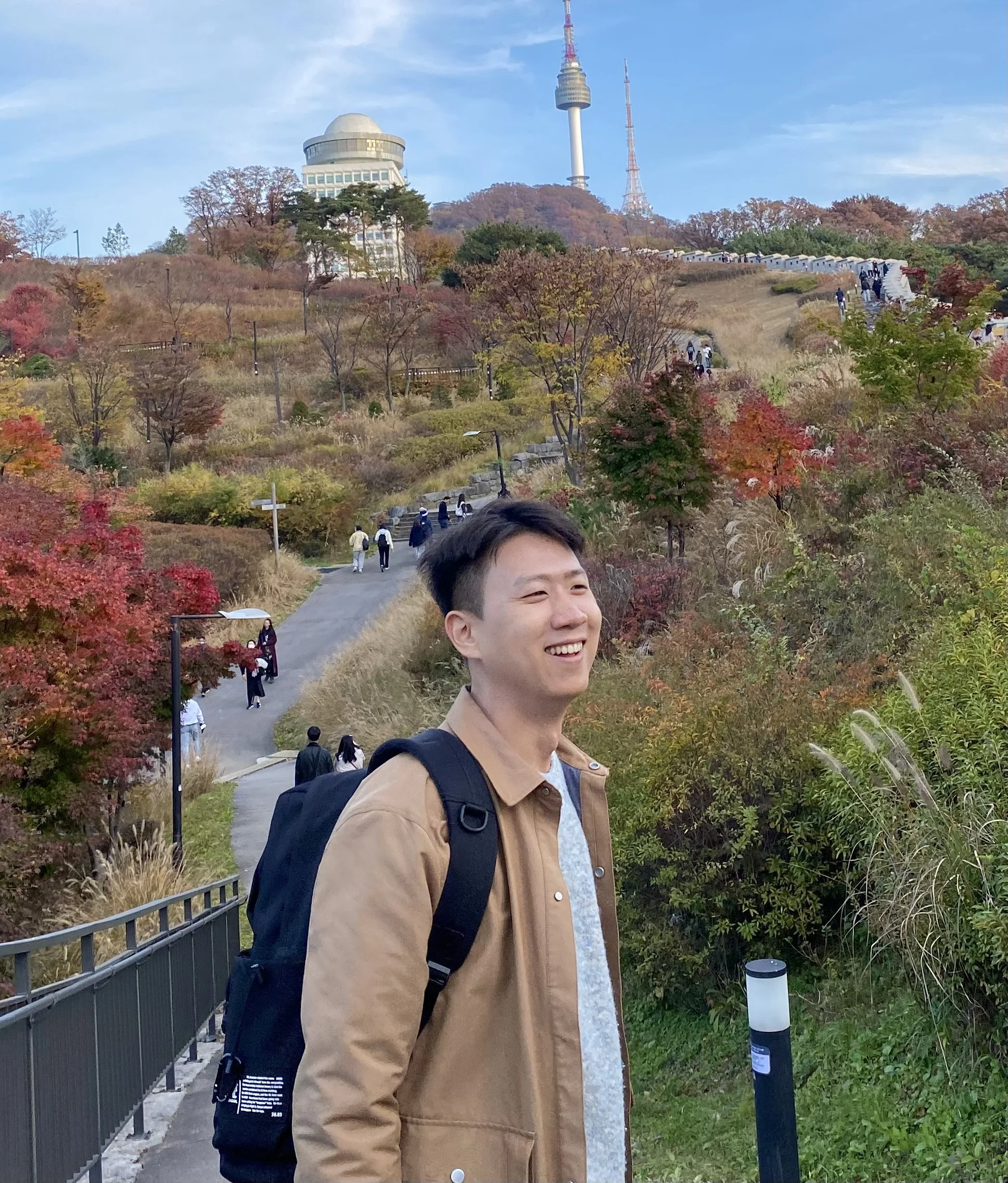
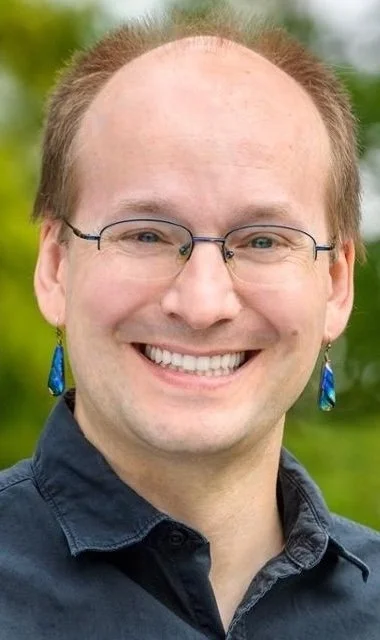
Prof. Charles Collett
The Collett lab at Hamilton College explores a variety of quantum spin systems as possible building blocks for quantum computers (qubits), using the tool of electron spin resonance (ESR). Charles and his team mainly focus on a class of spin systems called molecular nanomagnets (MNMs), which can be chemically engineered to have various useful properties, including clock transitions to increase the quantum state lifetime, and multiple coupled spins to act as multi-qubit systems. They have developed novel spectrometers and resonators to enable multi-tone ESR to interact with several spins in a single sample with excitation frequencies separated by more than 1 GHz, and are using them to demonstrate multi-qubit gates in MNM dimer systems at temperatures down to 1.5 K. In collaboration with the LHQS, they are also exploring how their resonators can facilitate the study of hybrid quantum systems, mediating the interactions between different qubit modalities. Much of the work in the Collett Lab, both experimental and theoretical, is done by the wonderful undergraduate student researchers at Hamilton!
Graduate Students

Austin Schleusner
Austin is working with the SQUILL Foundry at MIT Lincoln Laboratory to develop novel cQED-based hybrid systems integrating electrons on helium with superconducting qubits. Additionally he is investigating the high-frequency non-linear dynamics of electrons on helium. These experiments are aimed at understanding the interplay between the high-frequency collective response of the electron system and its coupling to the bosonic field of excitations on the surface of the helium.

Camryn Undershute
Camryn’s research interests involve superfluids, superconducting circuit-based qubits, and hybrid quantum acoustic systems. These systems reside at the exciting and ever-evolving intersection of condensed matter physics and quantum information science. Before joining the LHQS Camryn’s research was focused on understanding the role of finite-size effects in nano-confined quantum fluids. She is also an accomplished figure-skater.

Alex Carrothers
Alex is working to develop novel quantum acoustic devices based on surface acoustic wave (SAW) and bulk acoustic wave (BAW) resonators on novel piezoelectric materials. Before starting his Ph.D. work at MSU, Alex got his undergraduate degree in physics at the University of Mount Union. Alex is also an accomplished wrestler.
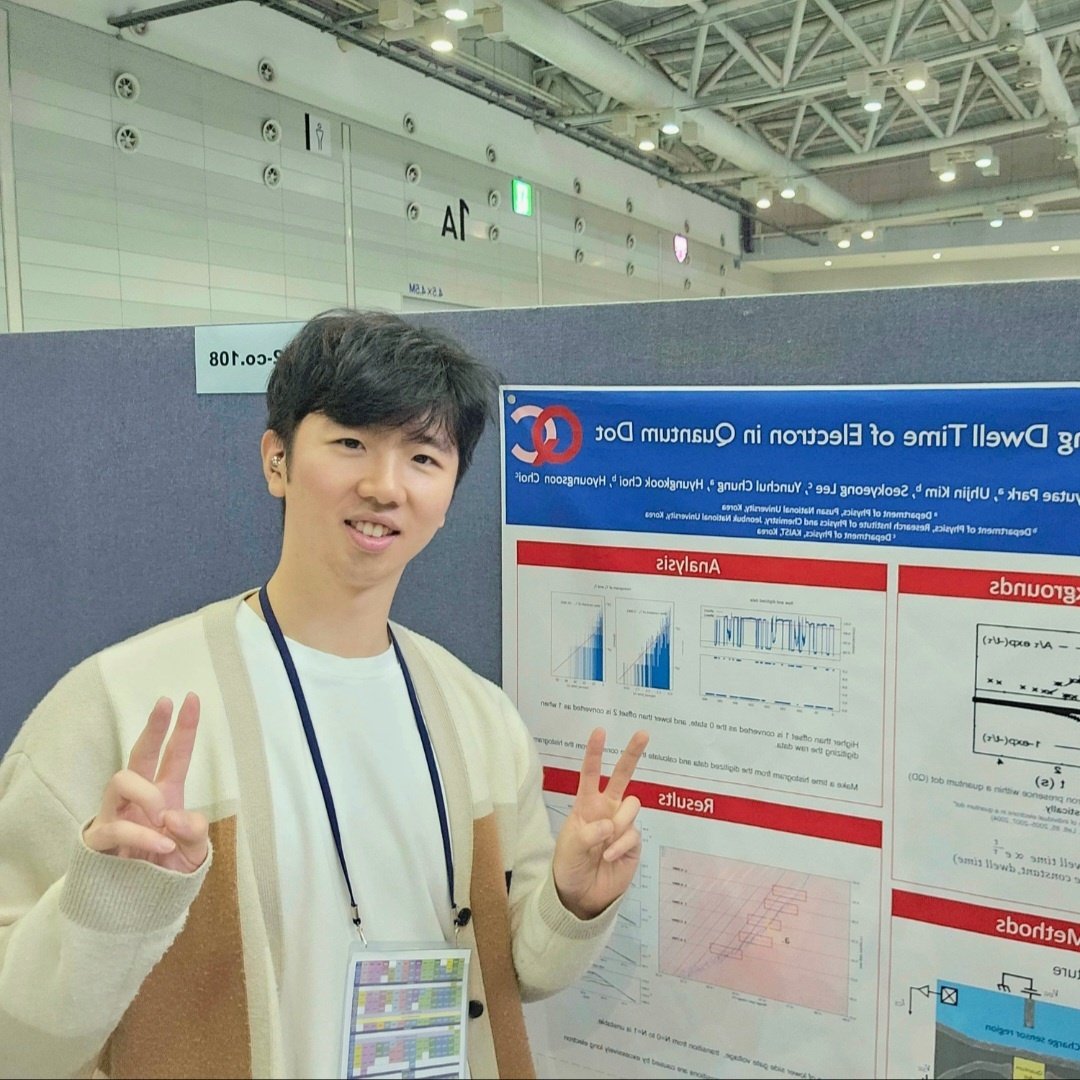
Hyeon SeonWoo
Hyeon is investigating hybrid quantum systems based on electron trapped above the surface of superfluid helium. Before joining the LHQS, Hyeon received a bachelor and master's degree in Physics from Pusan National University in South Korea. During that time his research was focused on low-dimensional electron transport in AlGaAs/GaAs devices. In particular, he studied electron tunneling in semiconductor quantum dots with thick tunneling barriers.
Engineers

Monawar Mesbah
Monawar graduated from MSU in the Spring of 2025 with a Bachelor of Science degree in Computer Engineering and is now a Ph.D. in ECE at the University of Florida. At the LHQS Monawar worked on a team to develop, design, fabricate and measure SAW and HBAR quantum phononic devices as well as novel quantum acoustic systems based on high-impedance superconductors. Additionally he assisted on numerous other projects including efforts to develop novel electron sources for hybrid systems based on electrons on helium.
We're always on the lookout for enthusiastic folks to join the LHQS team! If you're interested in our research send Johannes Pollanen an email to inquire about possible openings.
Quisque iaculis facilisis lacinia. Mauris euismod pellentesque tellus sit amet mollis.